
Task Batching
Group similar tasks into a single block to reduce the mental cost of switching between different types of work. For example, handle all correspondence in one block and all document creation in another.
Learn how dividing your calendar into dedicated segments can help reduce context switching, protect focused work time, and give your daily schedule a reliable, navigable shape.
Time blocking is the practice of dividing your workday into distinct segments and assigning specific types of work — or individual tasks — to each segment. Rather than working from an open-ended to-do list, you work from a schedule that tells you what to focus on and when.
The approach is not about rigidity. It is about giving your attention a clear landing place. When you sit down to work, you know what the current block is for, which removes the moment-to-moment decision about what to do next.
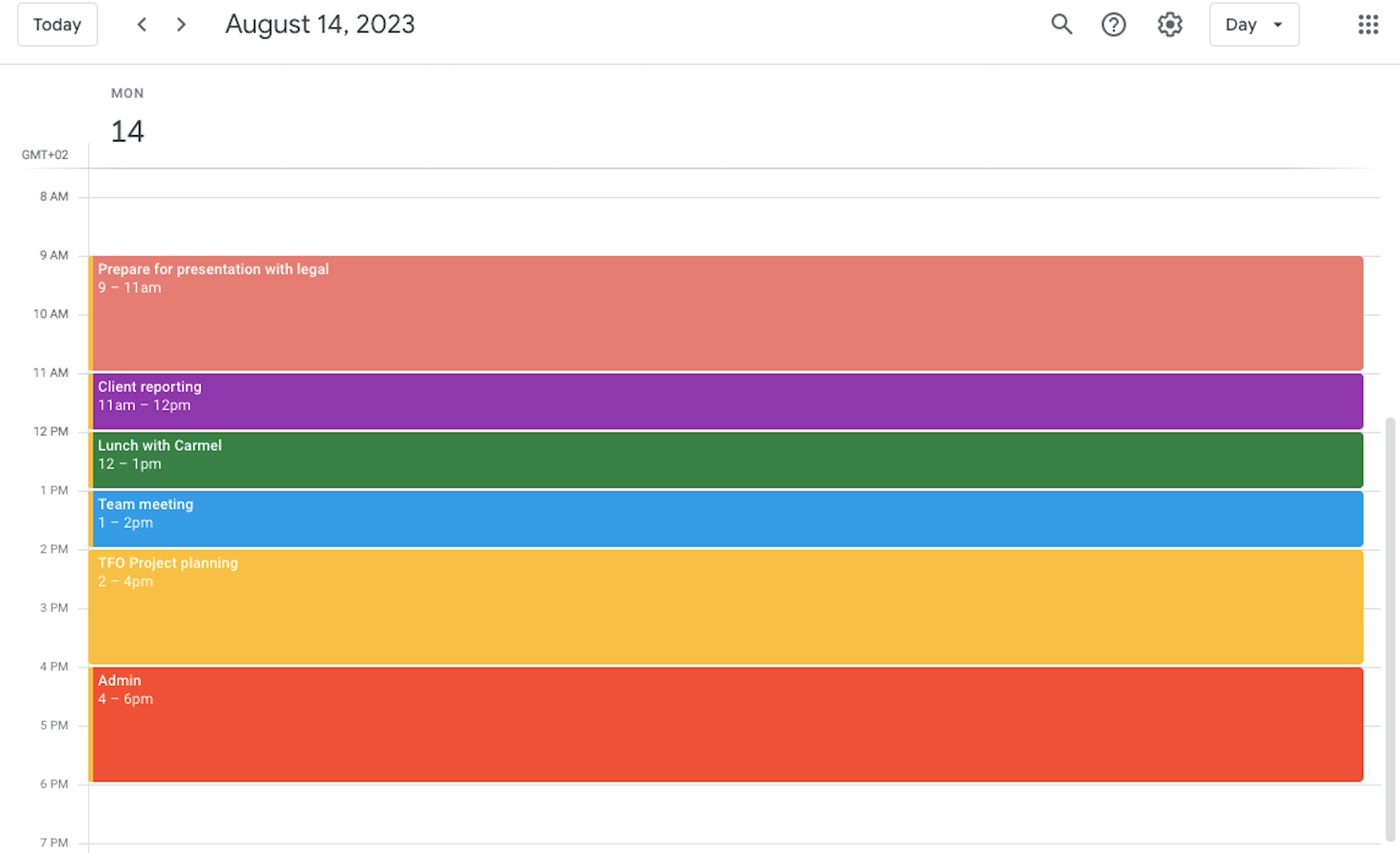
There are several variations of time blocking, each with a different emphasis. Exploring more than one can help you identify which fits your working style.
Group similar tasks into a single block to reduce the mental cost of switching between different types of work. For example, handle all correspondence in one block and all document creation in another.
Assign each day of the week to a broad category of work. One day might focus on communication-heavy tasks, another on creative or complex work, and another on administrative responsibilities. This reduces context switching across days rather than within them.
Set a fixed time limit for a task regardless of whether it is complete. When the box ends, you stop and assess. Timeboxing can be useful for tasks that tend to expand beyond their necessary scope.
Work in focused intervals — commonly 25 minutes — followed by a short break. After a set number of intervals, take a longer break. This rhythm suits some people well for tasks requiring sustained concentration over extended periods.
Schedule your most demanding tasks during the times of day when your energy and concentration tend to be highest. Reserve lower-demand tasks — such as reviewing messages or routine administration — for lower-energy periods.
Intentionally leave unscheduled time between blocks to accommodate unexpected tasks, overruns, or transitions. A schedule without buffer tends to compress under real-world conditions, making it harder to follow.
Starting with time blocking does not require a complex system. The following steps describe a straightforward approach to building a time-blocked schedule from scratch.
A time-blocked schedule will rarely be followed perfectly — and that is acceptable. The planning process itself creates clarity, even when the plan requires adjustment.

Time blocking works most effectively alongside a clear sense of which tasks deserve the most protected time. If you have not yet read the prioritization guide, it is a natural companion to this one.
Understanding how to sequence your tasks gives time blocking its direction. The prioritization guide covers several frameworks that work well alongside a time-blocked schedule.